
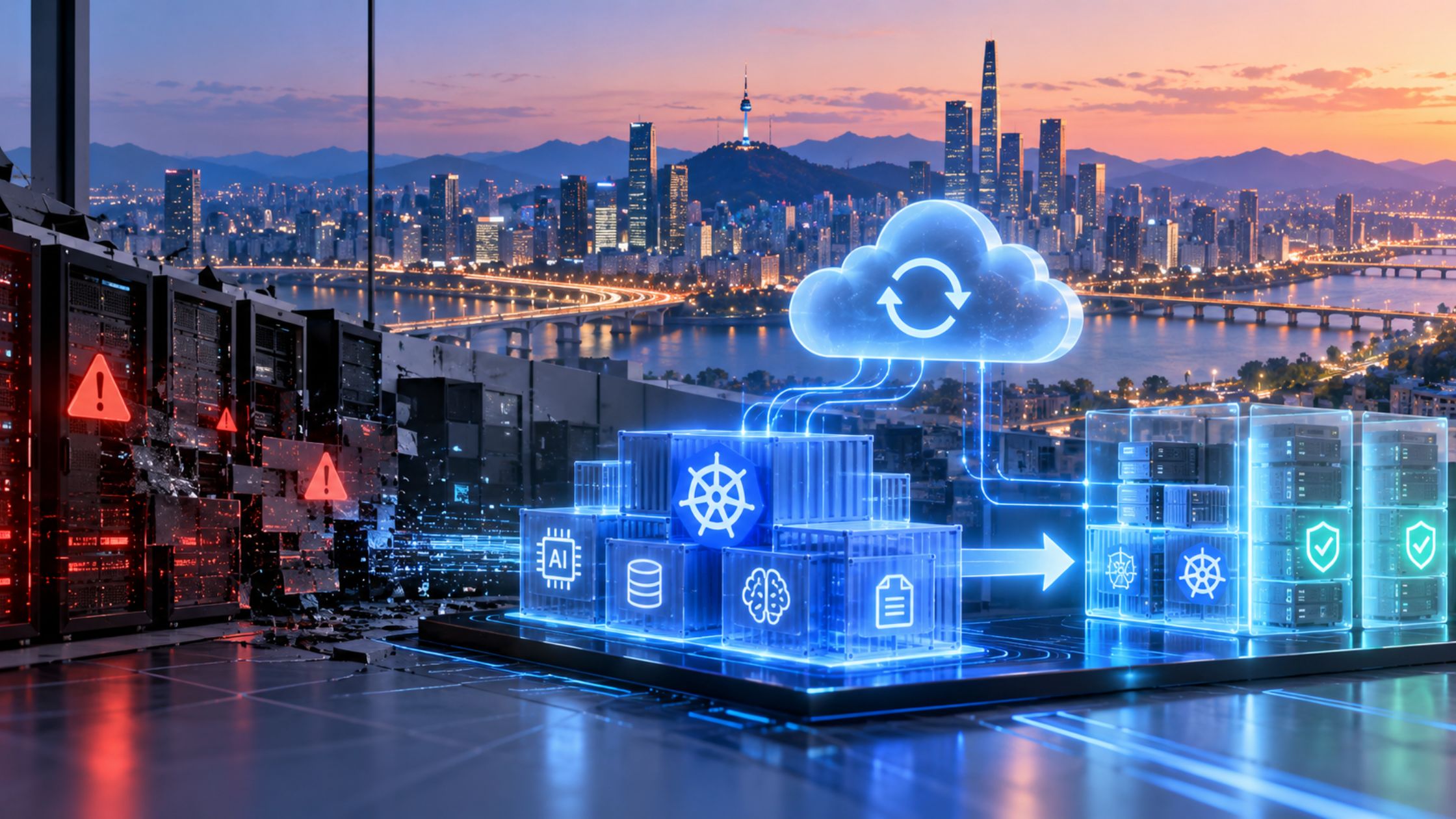
As Korean enterprises and public institutions modernize around AI, Kubernetes and cloud-native architectures, the ability to recover those workloads is becoming as important as the ability to deploy them.
South Korea is rapidly expanding the infrastructure needed to support its AI ambitions. In its 2026 plan, the Ministry of Science and ICT allocated KRW 4.46 trillion to nationwide AI transformation and planned to secure an additional 15,000 advanced GPUs, bringing the cumulative total to 37,000, alongside a National AI Computing Center and new AI networking infrastructure.
At the same time, Korea’s public sector is accelerating its shift toward cloud-native infrastructure. The Ministry of the Interior and Safety launched a nationwide survey in September covering cloud adoption and cloud-native conversion across administrative and public institutions, with the results intended to inform a government-wide cloud transition roadmap.
These developments point to a broader architectural transition. As AI workloads and modern applications increasingly run on containers and Kubernetes, organizations need to rethink not only how they deploy these systems, but also how they protect and recover them.
Kubernetes Is Becoming Part of the AI Infrastructure Stack
Globally, Kubernetes is increasingly becoming a foundation for production AI. The Cloud Native Computing Foundation’s 2026 survey found that 82% of container users were running Kubernetes in production, while 66% of organizations hosting generative AI models were using Kubernetes for some or all inference workloads.
Korea’s own digital-services ecosystem is reflecting this shift. A 2026 report supported by the National Information Society Agency described Kubernetes as increasingly becoming an operating layer for AI infrastructure, while highlighting the country’s growing GPU and cloud-native infrastructure build-out.
The significance for enterprises extends beyond orchestration. Kubernetes applications can involve distributed workloads, persistent storage, databases, configurations, secrets and dependencies that may span clusters, regions or cloud environments. Protecting an individual data component therefore does not necessarily mean the application itself can be restored and made operational.
That distinction becomes increasingly important as AI moves into production.
The Resilience Layer Can Fall Behind the Modernization Layer
The question of cloud-native data resilience is becoming increasingly important for Catalogic Software as it expands the reach of its Kubernetes-focused CloudCasa platform across Asia-Pacific. Catalogic provides data protection, recovery, disaster recovery and data management solutions for enterprise and cloud environments, while CloudCasa is its cloud-native platform built specifically for Kubernetes, cloud databases and modern applications.
The company has been expanding CloudCasa’s capabilities and ecosystem throughout 2026. In April, CloudCasa joined the Nutanix Kubernetes Platform Partner Catalog, adding Kubernetes-native backup, recovery, disaster recovery and migration capabilities for distributed environments. In June, it expanded its HPE partnership with Kubernetes disaster recovery using HPE Alletra storage replication, targeting faster recovery and near-zero data loss for critical workloads
The latest move came in August, when Tech Data, a TD SYNNEX company, was appointed distributor for CloudCasa in Singapore and Malaysia. The expansion builds on the companies’ existing partnership in Australia and New Zealand and is intended to help local resellers, managed service providers and system integrators address growing demand for Kubernetes data protection, disaster recovery and workload mobility.
KoreaTechToday spoke with Aravind Kurapati, Head of Channels and Alliances, APAC and GSI at Catalogic Software, about how the same infrastructure shift is playing out in South Korea. The conversation focused particularly on Korean enterprises adopting Kubernetes for modern applications and AI infrastructure, and whether their data-protection strategies are evolving at the same pace.
Kubernetes modernization can create a particular resilience challenge because the infrastructure supporting an application is no longer necessarily a fixed collection of servers or virtual machines. Applications can span containers, persistent storage, databases, configurations and multiple services, meaning that protecting individual components does not automatically guarantee that the complete application can be recovered.
That is where the risk of a resilience layer falling behind the modernization layer emerges.
While conversing with KoreaTechToday, Aravind Kurapati, Head of Channels and Alliances, APAC and GSI at Catalogic Software, said Korean enterprises are moving quickly on both Kubernetes and AI infrastructure, with the transition occurring across public and private sectors.
“Korean enterprises are moving fast on Kubernetes and AI infrastructure. We are seeing this play out at both ends of the market. On one hand, the government’s cloud-native mandate is pushing agencies toward Kubernetes as the default runtime for new and modernized systems. On the other hand, the generative AI wave is pulling even conservative sectors like banking into container-based, often on-premise or sovereign infrastructure to keep sensitive data inside a closed network. Both are real, healthy signals of maturity in the market.
Where we’ve seen this cause real trouble is at the modernization stage itself. We’ve watched multiple projects get delayed because data protection was treated as an afterthought – the platform and architecture decisions were made first, and only later did teams realize their legacy backup and recovery tooling simply wasn’t built for cloud-native workloads. It’s an easy blind spot to miss: the project looks like it’s on track because the migration itself is progressing, but the resilience layer underneath hasn’t been rearchitected to match, and that only surfaces once something actually goes wrong. That’s a real business risk in Korea specifically, given how much of the current build-out sits in regulated, high-stakes contexts, from financial institutions running sovereign AI on closed networks to public agencies migrating live citizen-facing systems, where recovery has to work the first time.”
The observation highlights a structural problem in modernization: migration does not automatically equal resilience.
Sovereign AI Makes Recovery a Separate Question
Korea’s move toward controlled AI environments makes the issue particularly relevant. In January 2026, the Bank of Korea and NAVER completed BOKI, a dedicated generative AI platform operating on-premises inside the central bank’s internal network and isolated from external networks. AI training and inference are performed within that closed environment to meet the security requirements of a central financial institution.
The example illustrates an important distinction between security, sovereignty and resilience. Keeping sensitive data within a controlled environment can reduce exposure and address sovereignty requirements. But it does not, by itself, answer what happens if the underlying infrastructure fails, data becomes corrupted or an AI workload has to be reconstructed.
For enterprises running sensitive AI systems, the question increasingly becomes not simply where data resides, but whether the complete application environment can be recovered within an acceptable timeframe.
Korea’s Public Sector Is Already Rethinking Disaster Recovery
The issue is also becoming more visible at the infrastructure level. Following the 2025 fire at the National Information Resources Service, the Korean government began planning Active-Active disaster-recovery architectures for critical public systems. In June 2026, the Ministry of the Interior and Safety announced an ISP project covering 13 systems, including systems involving private-cloud migration and disaster recovery. The government said it would subsequently expand the DR architecture.
The incident was not a Kubernetes-specific failure, but its implications are relevant to Korea’s broader modernization agenda. As public systems become more cloud-native and AI-enabled, resilience has to be designed alongside the architecture rather than added after deployment.
KT Cloud’s own 2026 infrastructure strategy illustrates this convergence. Its Kubernetes-based OpenStack platform integrates VM and container environments and uses multi-region and multi-availability-zone architecture to strengthen disaster recovery and service continuity, including for AI infrastructure.
What Data Protection Needs to Mean for AI Workloads
For Korean enterprises, the resilience conversation therefore needs to expand beyond conventional backup.
The questions increasingly include:
- Can the complete application environment be reconstructed?
- How quickly can critical AI workloads return to operation?
- Can workloads move between clusters or infrastructure when required?
- Has recovery actually been tested under realistic failure conditions?
- Can recovery meet data sovereignty and regulatory requirements?
This is also where purpose-built Kubernetes protection platforms are emerging. Catalogic’s CloudCasa, for example, is designed for Kubernetes and cloud-native applications with backup, recovery, disaster recovery and workload mobility across clusters and cloud environments.
The broader market shift is significant because it reframes data protection from an infrastructure utility into part of application architecture.
Aravind expects this shift to accelerate as customers and regulators ask more pointed questions about recovery guarantees for AI workloads.
“Over the next year, we expect that to shift, with data protection moving earlier into the conversation as regulators and enterprise customers start asking pointed questions about recovery guarantees for AI workloads – not just where the data lives, but how fast and how completely it can come back. That’s a real opening for local partners and system integrators: the ones who build data resilience into their Kubernetes and AI practice from day one of a project, rather than treating it as a follow-on service, are going to be the ones enterprises trust with the next wave of AI infrastructure investment.”
Korea’s AI infrastructure race is increasingly about building systems that can operate at scale. But infrastructure maturity cannot be measured only by compute capacity, model performance or deployment speed.
As AI becomes embedded in Kubernetes-based applications and critical public and private-sector systems, the ability to recover those environments becomes part of the infrastructure itself.
For Korea’s next phase of AI modernization, data protection may therefore need to move from the final stage of deployment to the first stage of architecture planning. The question is no longer simply whether an organization can run AI. It is whether it can recover AI when the infrastructure around it fails.