
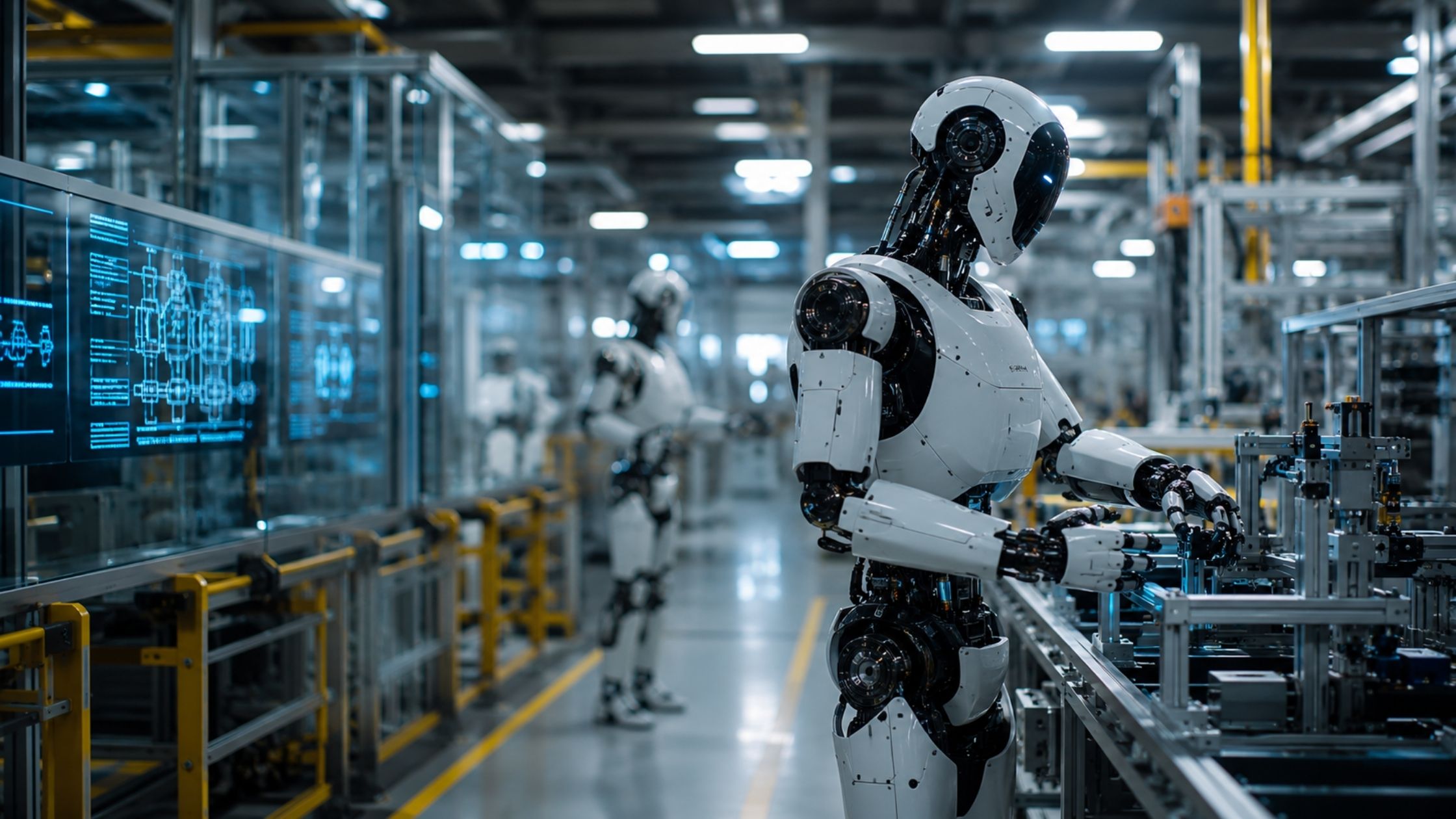
As Seoul commits billions of won to physical AI and investors back humanoid robotics, South Korea is betting that its industrial strengths can turn AI into a globally competitive physical technology.
For much of the current AI cycle, South Korea’s strategy has been focused on the infrastructure behind intelligence: semiconductors, GPUs, data centers and AI models. That strategy is now expanding. On August 27, the South Korean government announced plans to invest KRW 2.3 trillion ($1.66 billion) through 2030 to build a domestic humanoid robotics ecosystem, beginning with KRW 600 billion next year. It also plans to invest another KRW 2.8 trillion in physical-AI demonstrations across eight areas including autonomous manufacturing, logistics, agriculture, construction, care and defense.
The government intends to raise the localization rate of core humanoid components from 45% to 80% and purchase 1,080 domestically developed humanoids by 2030. The scale of the commitment signals something bigger than a robotics program. South Korea is beginning to treat physical AI as the next industrial layer of its AI strategy. Atinum Investment, one of the investors backing Korean humanoid startup Holiday Robotics, sees the same shift from the perspective of private capital.
“We believe the center of gravity in AI is shifting from building larger and more capable models to applying AI in the real world,” an Atinum Investment spokesperson told KoreaTechToday. “Physical AI, where AI interacts with and acts in the physical world, is one of the areas where we see significant potential, and humanoid robotics is at the center of this transition.”
The question now is whether Korea can turn its existing industrial strengths into an advantage in this emerging market.
AI is moving into the physical economy
The rise of physical AI does not mean foundation models are becoming less important. Rather, models are becoming one layer in a much larger system. A physical-AI machine has to perceive its environment, interpret what it sees, make decisions, control hardware and respond to changes in the physical world. A humanoid picking up a component, for example, must account for position, weight, friction, force and unexpected movement in ways that a software application does not.
That makes physical AI fundamentally multidisciplinary. It brings together AI models with sensors, actuators, semiconductors, batteries, control systems, simulation and robotics. For South Korea, that convergence is significant because many of those capabilities already exist inside its industrial economy.
Korea’s manufacturing base could become an AI advantage
South Korea has spent decades developing advanced capabilities in semiconductors, electronics, automotive manufacturing, batteries and industrial automation. Its next opportunity may be to connect those capabilities to intelligent machines. The government’s latest humanoid strategy explicitly targets this integration. It plans to establish mass-production systems for humanoids customized for 10 major industries while developing domestic technologies for areas such as actuators, robotic hands, sensors, AI chips, batteries and robot operating systems.
This matters because physical AI cannot be commercialized through software alone. A country can develop an impressive AI model without possessing the manufacturing infrastructure needed to turn that intelligence into a reliable machine. Korea already has much of the physical supply chain.
Hyundai Motor Group is pursuing a similar strategy. Its AI robotics program seeks to combine automotive manufacturing expertise with AI infrastructure, simulation and robotics, while the group is developing manufacturing and robotics facilities and an AI data center capable of handling data generated by physical-AI robots and autonomous vehicles. The emerging strategy is therefore not simply to build robots. It is to connect AI intelligence with Korea’s industrial production system.
The factory could become the next AI training environment
This is where physical AI differs most sharply from conventional software AI. A model can be trained against digital information at enormous scale. A robot has to learn from physical interactions. It needs to understand how objects move, how much force to apply, how to recover from errors and how to operate safely around people and expensive equipment. Factories can provide that environment.
Hyundai has said it plans to use manufacturing environments to train and validate its humanoid robots, with real-world operational data feeding back into the development process. Its broader robotics strategy is designed to leverage the group’s manufacturing capabilities and scale them into robotics production.
This creates a potentially powerful feedback loop: deployment generates data, data improves the robot, better robots enable more deployment. For Korea, this could become a structural advantage. Its factories are not simply potential customers for physical AI. They can also become environments in which physical AI systems are tested, refined and commercialized.
Investors are beginning to price that opportunity
Atinum Investment’s backing of Holiday Robotics illustrates how this transition is influencing venture capital. Holiday Robotics raised $105 million in Series A funding in July, with the company describing its focus as building humanoids for real industrial work rather than demonstrations. Its platform combines the FRIDAY humanoid with simulation and robot-learning technologies intended to improve deployment in manufacturing environments.
For Atinum, the investment is based on more than the near-term potential of one robot.
“Advances in AI and robotics are converging rapidly, while demand for automation in manufacturing and logistics is creating clear real-world use cases for humanoid robots,” the spokesperson told KoreaTechToday.
The firm also believes Holiday could become a global category leader.
“Atinum Investment looks beyond near-term milestones and focuses on whether a company has the potential to become a category-defining business worth billions of dollars globally. We believe Holiday Robotics has that potential.”
That is an important change in the investment proposition. Physical-AI companies cannot be evaluated solely through the conventional software metrics of user growth or marginal distribution costs. Investors have to assess hardware, components, manufacturing, AI, data, deployment and service as parts of one system.
Seoul is trying to create the market, not just fund the technology
The government’s strategy goes beyond research funding. By purchasing 250 domestically developed humanoids next year and 1,080 by 2030, Seoul is positioning itself as an early customer while creating demand for domestic components and software. The government also plans more than 500 physical-AI test sites next year across eight sectors.
This approach attempts to solve one of the hardest problems facing emerging hardware industries: the gap between prototype and market. If startups can access government-backed testing environments, industrial partners and early customers, they may be able to accumulate the operational data needed to improve their machines. But public procurement alone cannot establish a sustainable industry. Ultimately, robots have to demonstrate that they can deliver more economic value than the automation systems they are replacing or supplementing.
Korea still has to prove the economics
That is where the country’s physical-AI strategy faces its biggest test. Traditional industrial robots are already highly reliable for structured tasks. Humanoids are more flexible, but that flexibility comes with greater mechanical and computational complexity.
China’s experience illustrates the challenge. More than 150 companies are reportedly pursuing humanoid robotics there, supported by substantial government investment, yet many systems still struggle with the precision, adaptability and intelligence required for genuine factory work. Korea therefore cannot assume that capital and manufacturing expertise will automatically translate into leadership.
It also has to address workforce concerns. Hyundai’s latest labor agreement acknowledged the impact of AI and robotics on future employment and established continued discussions around job security as automation expands. The success of physical AI will ultimately depend on whether it can improve productivity while creating an economically and socially workable model for deployment.
From AI infrastructure to AI productivity
Atinum’s investment thesis captures the strategic shift underway in Korea. The country’s first AI opportunity was largely upstream: supplying semiconductors, computing power and infrastructure to an expanding global AI industry. Physical AI creates a different opportunity. It asks whether those industrial capabilities can be combined with intelligence to produce machines capable of performing useful work.
That is why Atinum’s broader objective is significant.
“As a large-fund investor, Atinum Investment can make meaningful follow-on investments in companies where we have strong conviction,” the spokesperson said. “Our goal is not simply to invest in promising companies, but to help build globally competitive companies from Korea.”
South Korea now has many of the ingredients required for that ambition: advanced manufacturing, semiconductor expertise, industrial automation, AI infrastructure, large corporate customers, government support and increasingly ambitious venture capital.
The difficult part will be connecting them. If Korea succeeds, its next AI advantage may not come from building a larger model. It may come from turning intelligence into productivity on the factory floor, in warehouses, vehicles and other physical environments.
The transition from models to machines is therefore not about replacing software with hardware. It is about making intelligence useful in the physical economy. For South Korea, that could be the next major test of whether its industrial base can once again become the foundation for a globally competitive technology category.