
As enterprises move beyond standalone AI assistants, coordinated teams of specialized AI agents are emerging as the next frontier of enterprise software, reshaping how organizations make decisions and redefining the role of human professionals.
For much of the past two years, the enterprise AI conversation has centered on copilots. From generating documents and writing software code to summarizing meetings and answering questions, AI assistants have rapidly become embedded in everyday workflows. Their adoption has been equally rapid. According to a recent McKinsey survey, 78% of organizations now use AI in at least one business function, while generative AI adoption continues to expand across industries, reflecting the technology’s transition from experimentation to operational deployment. At the same time, enterprises are beginning to recognize that isolated AI assistants, while valuable, are not sufficient for managing increasingly complex business processes.
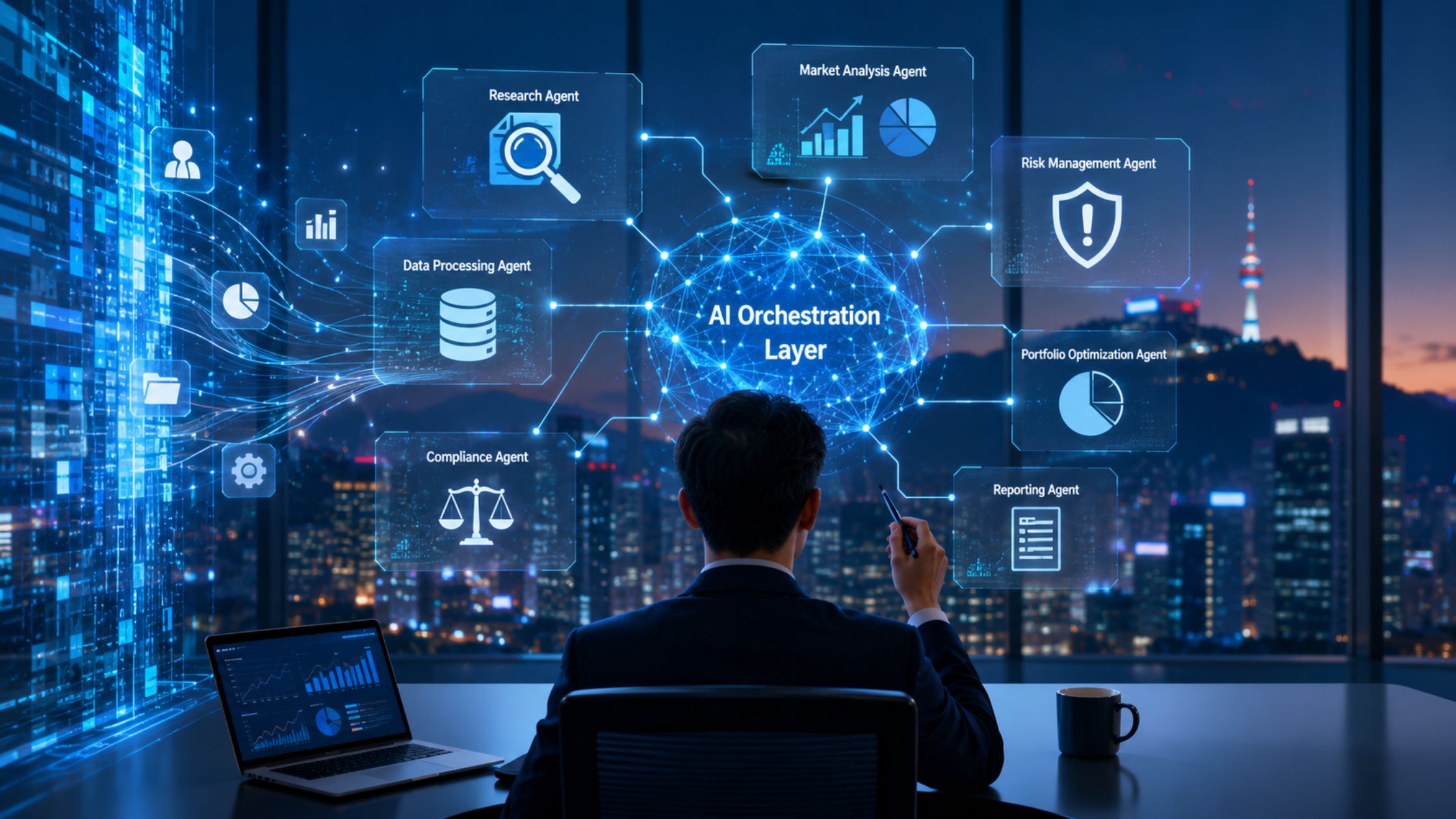
The next phase of enterprise AI is beginning to take shape around a different concept: agent orchestration. Rather than relying on a single AI assistant to support individual employees, organizations are increasingly exploring systems in which multiple specialized AI agents collaborate across interconnected workflows. One agent may analyze financial statements, another may monitor regulatory changes, while others evaluate operational risks, generate reports, or coordinate with enterprise systems. Human professionals remain central to the process, but their responsibilities increasingly shift toward directing, validating, and orchestrating AI-driven work instead of manually completing every task themselves.
This emerging model is gaining momentum across enterprise software. Major technology companies including Microsoft, Salesforce, Google Cloud, and ServiceNow have all expanded investments in agent-based enterprise platforms, reflecting growing recognition that the future of enterprise AI will depend not only on model performance but also on how multiple AI systems work together under human supervision.
Copilots Solved Individual Productivity. Enterprises Need Workflow Intelligence.
The first generation of enterprise AI focused primarily on enhancing individual productivity. AI copilots helped employees draft emails, summarize documents, generate software code, search enterprise knowledge bases, and automate repetitive administrative work. These capabilities significantly reduced routine workloads while improving access to information.
However, enterprise operations rarely consist of isolated tasks. A single business decision often requires data from multiple departments, regulatory verification, financial analysis, historical context, and coordination across different enterprise applications. A standalone AI assistant may complete one task efficiently, but organizations increasingly require AI systems capable of coordinating entire workflows.
This has led enterprises to rethink how AI should be deployed. Instead of asking whether one increasingly powerful model can perform every function, businesses are beginning to ask how specialized AI agents can work together while remaining aligned with organizational policies, governance frameworks, and human oversight. The conversation is therefore shifting from AI assistance toward AI coordination.
The Rise of Agent Orchestration
Agent orchestration represents one of the most significant developments in enterprise AI. Rather than assigning every responsibility to a general-purpose model, organizations increasingly deploy specialized AI agents designed for distinct domains such as finance, legal analysis, compliance, procurement, cybersecurity, customer service, or software engineering.
These agents collaborate under orchestration frameworks that determine:
- which agent performs each task,
- how information flows between agents,
- when human approval is required,
- and how outputs are validated before decisions are implemented.
This approach addresses several enterprise challenges simultaneously. It improves explainability by assigning clearly defined responsibilities to individual agents. It strengthens governance by introducing human checkpoints into automated workflows. It also enables organizations to integrate proprietary enterprise knowledge without relying entirely on generalized foundation models.
Industry analysts increasingly view orchestration as a defining capability for enterprise AI because business value no longer depends solely on building larger language models. Instead, it depends on coordinating multiple specialized systems capable of solving complex organizational problems while remaining secure, auditable, and aligned with business objectives.
Humans Are Becoming AI Orchestrators
The shift toward multi-agent systems also changes the role of knowledge workers. Rather than replacing human expertise, enterprise AI increasingly augments it by automating repetitive execution while elevating human responsibilities toward strategic reasoning, oversight, and judgment.
While conversing with KoreaTechToday, Hojun Choi, Co-Founder and Co-CEO of LinqAlpha, described this transition as one of the defining characteristics of the next generation of enterprise AI.
“Humans will be liberated from mundane tasks and pushed to orchestrate groups of agents capable of emulating the human managers’ depth of thinking, entering the era of accelerated & augmented thinking.”
As AI systems assume more operational responsibilities, professionals increasingly become supervisors of intelligent systems rather than direct executors of every task. Their value shifts toward defining objectives, evaluating outputs, challenging assumptions, managing risk, and making strategic decisions that remain beyond the capabilities of autonomous software.
This transition also introduces a new category of enterprise skills. Organizations will increasingly require employees who understand not only their business domain but also how to coordinate multiple AI systems effectively while ensuring governance, transparency, and accountability.
Finance Offers an Early Blueprint
Institutional investing provides one of the clearest examples of why agent orchestration is emerging. Financial professionals operate in environments where decisions require simultaneous analysis of structured data, unstructured documents, regulatory disclosures, macroeconomic developments, company fundamentals, portfolio risks, and market sentiment.
Rather than relying on one general-purpose AI model, future investment workflows may involve specialized agents responsible for:
- analyzing earnings reports,
- monitoring regulatory filings,
- evaluating macroeconomic developments,
- assessing portfolio exposure,
- identifying compliance risks,
- and generating investment research.
Human portfolio managers would then review, synthesize, validate, and challenge these outputs before making investment decisions. This collaborative model preserves human accountability while allowing AI systems to process vastly greater amounts of information than traditional research teams could reasonably analyze alone. Companies such as LinqAlpha are building domain-specific AI platforms designed for precisely these high-complexity environments, reflecting a broader enterprise trend toward specialized vertical AI rather than one-size-fits-all assistants.
South Korea’s Enterprise AI Ecosystem Is Following a Distinct Path
South Korea’s enterprise AI landscape is evolving differently from the global race to develop ever-larger foundation models. Rather than competing directly with the largest language model developers, many Korean AI companies are focusing on highly specialized enterprise applications across finance, manufacturing, healthcare, legal services, and industrial automation.
This approach aligns well with the country’s industrial strengths. South Korea’s globally competitive financial institutions, advanced manufacturing sector, semiconductor industry, and digitally mature enterprises create strong demand for AI systems capable of solving industry-specific problems while satisfying strict governance and regulatory requirements.
Recent investments into companies developing vertical AI platforms suggest growing confidence that specialized enterprise intelligence may offer greater long-term commercial value than generalized AI assistants alone.
The Next Enterprise AI Race Is About Coordination
The evolution of enterprise AI is increasingly becoming less about individual models and more about how intelligence is organized across organizations. The first wave of generative AI demonstrated that machines could assist individual workers. The next phase aims to coordinate specialized AI systems capable of supporting entire business processes while preserving meaningful human oversight.
Success in this new environment will depend on more than computational power. Enterprises will need robust governance frameworks, trusted proprietary data, secure orchestration layers, and professionals capable of directing increasingly sophisticated AI ecosystems. For South Korea, this transition presents an opportunity to strengthen its position in enterprise software by building specialized AI platforms that address complex, high-value business workflows rather than competing solely in the race for foundational models.
As organizations move beyond copilots, the competitive advantage will increasingly belong to those that can effectively orchestrate intelligence across humans and machines. In that emerging landscape, the future of work may not be defined by replacing professionals with AI, but by empowering professionals to coordinate intelligent systems that amplify expertise, accelerate decision-making, and unlock new forms of enterprise productivity.