
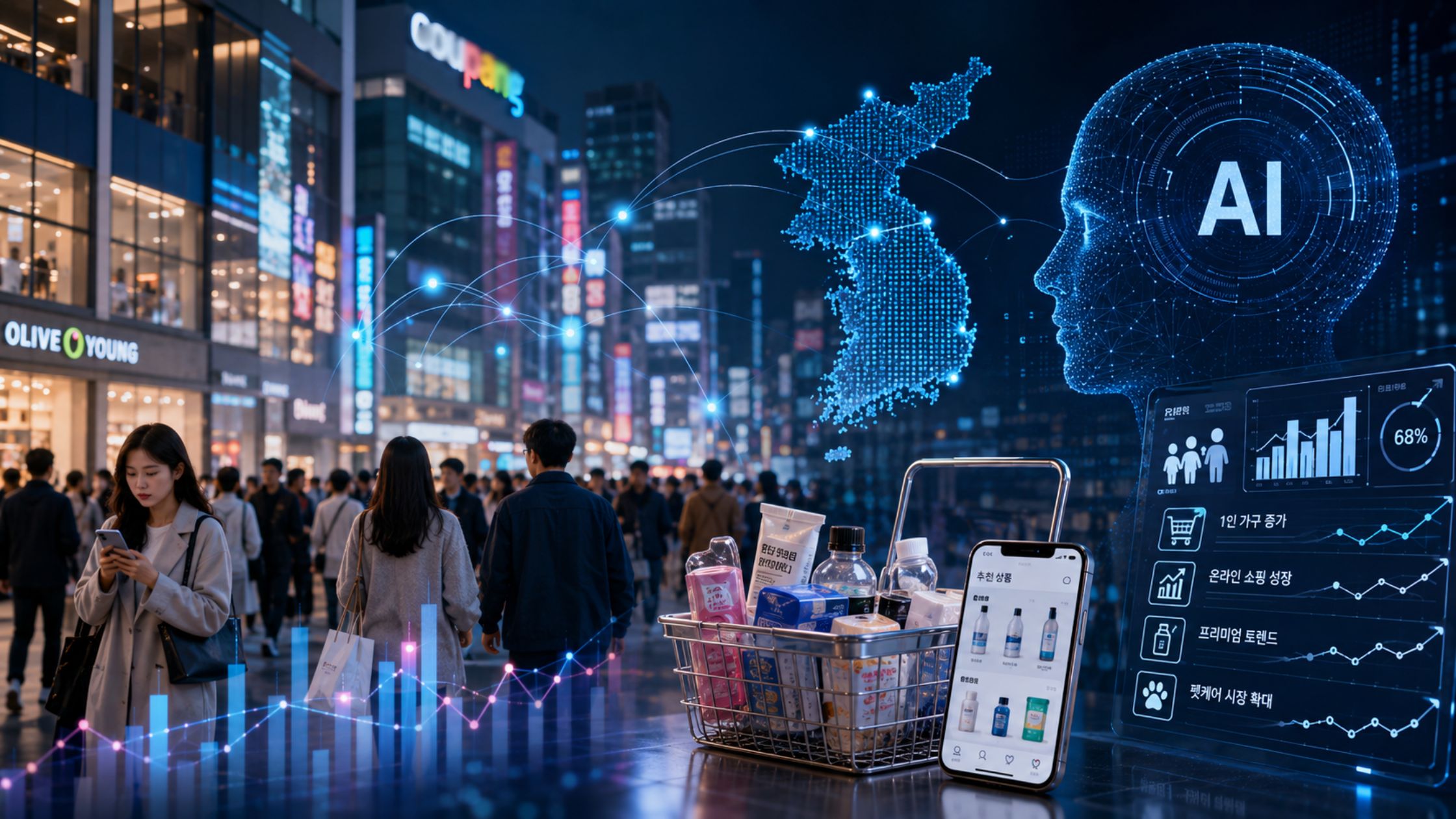
As household structures, shopping habits, and digital commerce reshape consumer behavior, brands are increasingly relying on AI powered by trusted behavioral data to make faster, more precise business decisions.
South Korea’s fast-moving consumer goods (FMCG) market is often viewed through familiar metrics such as retail sales, market growth, and consumer spending. But a closer look at recent market dynamics suggests that these traditional indicators are becoming less effective at explaining how consumers actually behave.
According to the latest “FMCG Market Changes and Strategic Outlook for 2026” report by Worldpanel by Numerator, the country’s FMCG market grew 3.4% in value during 2025, despite purchase volumes declining by 0.6%. Rather than signaling a temporary slowdown, the figures point to a more fundamental transformation. Consumers are not simply buying more or less. They are shopping differently, responding differently to pricing, moving across channels more fluidly, and making increasingly personalized purchasing decisions shaped by lifestyle, convenience, and digital experiences.
For technology companies and enterprise leaders, this shift carries implications far beyond retail. It is changing how artificial intelligence is deployed across organizations. Instead of relying on broad demographic analysis and historical market averages, businesses are increasingly turning to AI supported by high-quality behavioral data to understand increasingly fragmented consumer journeys and make faster, more informed commercial decisions.
South Korea, with its digitally connected consumers, mature e-commerce ecosystem, and rapidly evolving demographics, offers one of the clearest examples of how consumer intelligence itself is becoming a strategic technology capability.
The Era of the “Average Consumer” Is Coming to an End
For decades, consumer research was built around averages. Brands measured household spending, tracked broad demographic groups, and developed products intended to appeal to the largest possible audience. Those approaches remain useful, but they are becoming less effective in markets where consumer behavior is diverging at an unprecedented pace.
South Korea illustrates this transformation particularly well. Single-person households continue to expand, creating demand for smaller package sizes, ready-to-eat meals, and products designed around convenience rather than family consumption. Meanwhile, rising living costs have encouraged more selective spending, while premium categories such as personal care continue to attract consumers willing to pay more for products they perceive as offering greater value.
Shopping behavior has also become increasingly fluid. Online marketplaces, particularly platforms such as Coupang and Naver Shopping, now play a central role in product discovery and purchasing decisions. The report notes that Coupang recorded 3.7% value growth alongside a 0.9% increase in purchase count, reinforcing the continued strength of digital commerce even as consumer priorities evolve.
At the same time, entirely new consumption patterns are emerging. Pet ownership continues to grow across South Korea, driving demand for premium pet food, treats, and functional supplements. These categories are closely tied to digital commerce and increasingly personalized purchasing decisions, highlighting how lifestyle changes are reshaping long-term market opportunities.
Collectively, these developments demonstrate why broad market averages no longer provide sufficient insight into consumer behavior.
AI Is Becoming a Consumer Intelligence Engine
As purchasing patterns become more individualized, companies are asking fundamentally different questions than they did only a few years ago. Rather than simply measuring overall market growth, businesses increasingly need to understand:
- Which consumer segments are reducing purchases?
- Which shopping channels are gaining or losing momentum?
- How different households respond to pricing and promotions.
- How lifestyle changes are creating new demand patterns.
Answering these questions requires significantly more granular analysis than traditional market research can provide.
Speaking with KoreaTechToday, Youngmi Lee, Managing Director for South Korea at Worldpanel by Numerator, said one of the most significant changes in the market is that consumers can no longer be viewed as a single homogeneous group.
“One of the most important changes in South Korea’s FMCG market is that consumers can no longer be understood as one average group. Consumption patterns are becoming increasingly fragmented by household size, age, shopping channel, price sensitivity, and lifestyle.”
This growing fragmentation is pushing brands to rethink how they apply artificial intelligence.
Instead of using AI primarily for sales forecasting or demand prediction, organizations are increasingly applying machine learning and advanced analytics to uncover hidden behavioral patterns across thousands of consumer interactions. AI is becoming less of a forecasting tool and more of a decision-support system, helping businesses determine which products to develop, where to allocate marketing budgets, how to optimize pricing, and which channels deserve greater investment.
The shift reflects a broader evolution taking place across enterprise AI. Competitive advantage increasingly depends not only on building sophisticated algorithms but on applying them to highly specific business problems supported by rich behavioral intelligence.
Trusted Data Is Becoming AI’s Competitive Advantage
The rapid adoption of generative AI has often centered on model capabilities, computing power, and automation. Yet for enterprise applications, many organizations are discovering that technology alone rarely delivers meaningful business outcomes.
Instead, the quality of underlying data is emerging as the defining factor.
While speaking with KoreaTechToday, Lee emphasized that AI’s effectiveness ultimately depends on the information it analyzes rather than the sophistication of the technology itself.
“In this environment, digital technologies, data analytics, and AI play an important role in helping brands understand highly segmented consumers more quickly and precisely. However, the most important point is not the technology itself, but how it is connected with reliable data, especially actual purchase data, to support better business decision-making.”
That observation reflects a broader trend unfolding across enterprise technology.
As AI models become increasingly accessible, proprietary behavioral data is becoming a stronger source of competitive differentiation. Companies with reliable first-party purchase information, real-time consumer insights, and continuous behavioral tracking are better positioned to generate actionable intelligence than organizations relying solely on generalized market statistics.
This is particularly relevant in sectors such as retail, consumer goods, financial services, and digital commerce, where subtle changes in purchasing behavior can significantly influence pricing strategies, inventory planning, customer retention, and product development.
The conversation is therefore shifting from simply adopting AI to ensuring that AI operates on trustworthy, continuously updated, and representative datasets.
South Korea’s Digital Economy Offers an Early Glimpse of AI-Driven Retail
South Korea has long been recognized as one of the world’s most digitally advanced consumer markets. High smartphone penetration, sophisticated logistics networks, widespread digital payments, and strong e-commerce adoption have created an environment where consumer behavior evolves rapidly and is increasingly observable through digital interactions.
These conditions also make South Korea an important testing ground for AI-powered consumer intelligence.
As shopping journeys span physical stores, online marketplaces, mobile applications, social commerce, and subscription services, businesses must synthesize vast amounts of behavioral information to understand what consumers actually value. Traditional reporting cycles are giving way to more dynamic, continuous analysis capable of identifying emerging trends before they become visible in broader market statistics.
Rather than replacing human decision-making, AI increasingly augments it by enabling organizations to process enormous volumes of behavioral data at a scale impossible through conventional analysis alone.
For retailers and consumer brands, this capability is becoming essential as market growth depends less on attracting a single mass audience and more on serving numerous highly specialized customer segments.
Beyond Retail: Consumer Intelligence as Enterprise Infrastructure
The implications of South Korea’s changing consumer landscape extend beyond the FMCG sector. Many industries now face similar challenges. Financial institutions personalize products based on spending behavior. Healthcare companies tailor services around patient lifestyles. Mobility providers adapt offerings according to evolving travel patterns. Across sectors, organizations increasingly depend on behavioral intelligence rather than static demographic profiles to guide strategic decisions.
South Korea’s experience demonstrates that the future of AI in business is not simply about deploying more advanced algorithms. It is about combining those algorithms with reliable, high-quality behavioral data that reflects how consumers actually live, shop, and make decisions.
The country’s evolving FMCG market provides a clear illustration of this shift. As household structures diversify, digital commerce expands, and purchasing habits become more individualized, businesses can no longer rely on generalized assumptions about consumer demand.
Instead, success will increasingly depend on understanding thousands of distinct behavioral signals and translating them into faster, more precise business decisions. In that environment, AI is evolving from a productivity tool into a strategic intelligence layer, and trusted consumer data is becoming one of the most valuable assets organizations can possess.