

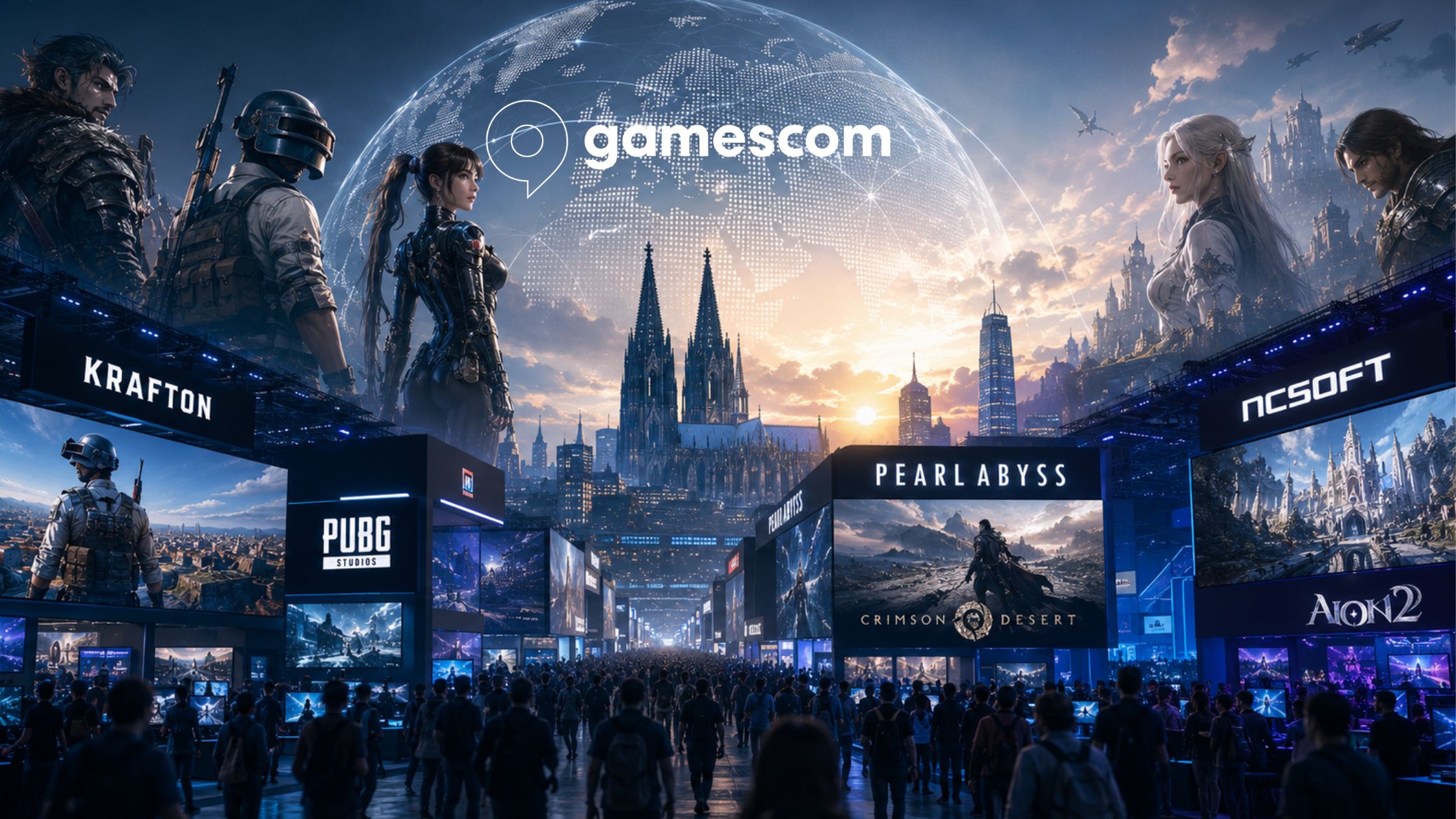
From AAA console titles and proprietary game engines to international publishing strategies, Korean developers are using Gamescom 2026 to demonstrate an industry that is increasingly focused on competing in the global premium gaming market.
As the world’s largest gaming exhibition prepares to open its doors in Cologne this August, South Korean game developers are arriving with a noticeably different strategy than in previous years. Rather than relying on a single flagship title or reinforcing their dominance in mobile gaming and MMORPGs, companies including Krafton, Pearl Abyss, and NCSoft are presenting broader portfolios that emphasize premium PC and console experiences, proprietary technologies, and global publishing ambitions. Gamescom 2026 is expected to be the largest edition yet, with record international participation following the event’s emergence as the industry’s premier global showcase after the closure of E3.
For South Korea’s gaming industry, this year’s event reflects more than a marketing opportunity. It illustrates a structural shift in how the country’s developers are positioning themselves in the global market. The focus is increasingly moving from exporting successful domestic business models to building internationally competitive intellectual property, attracting overseas publishers, and establishing long-term franchises capable of competing alongside major Western and Japanese releases.
Gamescom has evolved into a strategic platform for global expansion
Gamescom has long been an important consumer exhibition, but its significance has expanded considerably in recent years. Beyond attracting hundreds of thousands of visitors annually, the event has become a central meeting point for publishers, investors, technology partners, and media, making it one of the industry’s most influential business platforms. Organizers expect the 2026 edition to set new participation records, with exhibitors from more than 40 countries and national pavilions representing 23 countries. Last year’s event attracted approximately 357,000 visitors and over 1,500 exhibitors, underscoring its role as the largest annual gathering in the gaming industry.
Against this backdrop, South Korean companies are no longer treating Gamescom as simply another overseas exhibition. Instead, it has become a strategic venue to demonstrate technological capabilities, strengthen international partnerships, and validate new intellectual property before global audiences.
Korean publishers are showcasing broader strategies, not just new games
One of the defining characteristics of Korea’s presence this year is the breadth of what companies are bringing to Cologne.
Krafton, for example, will operate both business-to-business and consumer exhibition spaces, making it the only Korean publisher with a significant presence in both areas. Alongside the world’s first reveal of an unannounced PUBG Studios project, the company plans to showcase four additional publishing titles, reflecting its ongoing effort to diversify beyond the PUBG franchise and establish a broader portfolio of global intellectual property.
Pearl Abyss is taking a similarly multidimensional approach. While Crimson Desert remains the centerpiece of its Gamescom presence, the company is also using the event to highlight the capabilities of its proprietary BlackSpace Engine through technical sessions at Gamescom Dev. In partnership with Samsung Electronics, visitors will experience the game using the latest Odyssey gaming hardware, demonstrating not only the title itself but also the technological ecosystem supporting its development.
NCSoft, meanwhile, is leveraging Gamescom primarily as a business platform, introducing upcoming titles such as Aion 2 and Cinder City to overseas publishers and industry partners ahead of broader international launches.
Collectively, these strategies suggest that Korean developers are increasingly presenting themselves not merely as game creators, but as global entertainment companies with capabilities spanning publishing, engine development, live services, and international partnerships.
A broader transition beyond traditional market strengths
South Korea has long been recognized as one of the world’s most influential gaming markets, particularly in online PC games, esports, and mobile free-to-play experiences. Titles such as Lineage, MapleStory, Dungeon & Fighter, and Black Desert established Korean developers as leaders in persistent online worlds and monetization models.
However, the industry’s current trajectory reflects an expansion rather than a departure from those strengths.
The global success of premium titles such as Lies of P, Dave the Diver, Stellar Blade, and more recently Crimson Desert has demonstrated that Korean studios are increasingly capable of competing in segments historically dominated by Western and Japanese developers. Rather than focusing solely on domestic audiences or service-based mobile games, publishers are investing more heavily in narrative-driven console experiences, original intellectual property, and simultaneous worldwide launches.
Gamescom provides a highly visible stage for showcasing that evolution.
The presence of the Korea Creative Content Agency (KOCCA), which continues to support Korean small and medium-sized studios through a national pavilion, further highlights that this international expansion extends beyond major publishers. It reflects a broader national effort to strengthen Korea’s global competitiveness across the gaming ecosystem.
Global visibility alone will not determine success
While Korean companies have become increasingly successful at securing international attention, sustaining that momentum ultimately depends on how players respond once games reach the market.
Speaking with KoreaTechToday, George Jeong, Chief Global Officer at Minimap, argued that the industry’s competitive landscape has fundamentally changed.
“I think one of the biggest trends of the gaming industry, especially from the gamer side, is that the core foundation of any PC or console game has to keep its fun gameplay aspect. This may sound obvious for many, but sometimes studios are way too focused on improving graphics or adding more attractive characters when gamers nowadays are looking for a fun-to-play game.”
Jeong believes the challenge facing developers today extends well beyond competing against rival publishers.
“Their competition isn’t just other games now. The competition now lies beyond games like YouTube, TikTok, outdoor activities, Netflix and more. In one word, gamers will not buy your game if it is not fun.”
His observation reflects a broader shift across the entertainment industry. As consumers divide their leisure time across streaming platforms, social media, short-form video, and interactive entertainment, developers increasingly compete for attention rather than simply market share. Technical excellence and graphical fidelity remain important, but player engagement and compelling gameplay are becoming equally critical factors in determining commercial success.
The next chapter of Korea’s gaming industry
Gamescom 2026 illustrates how South Korea’s gaming industry is entering a new phase of international competition. Rather than relying primarily on established online franchises or mobile success, Korean publishers are increasingly investing in premium PC and console titles, proprietary technologies, diversified intellectual property, and overseas publishing capabilities.
The industry’s growing presence at Gamescom is therefore less about participating in another international exhibition and more about demonstrating its readiness to compete across the highest tiers of the global gaming market.
Whether these ambitions translate into sustained international success will depend not only on the scale of investment or the visibility generated at Gamescom, but also on the industry’s ability to create experiences that resonate with players in an increasingly crowded entertainment landscape. As Korean developers pursue broader global audiences, their long-term competitiveness may ultimately be measured not by the number of games they launch, but by how effectively those games capture and retain players’ attention.