
As AI becomes telecom’s defining axis, Korean operators attempt to move up the global value chain.
As the Mobile World Congress (MWC) 2026 approaches — set for March 2–5 in Barcelona — the narrative around global connectivity has shifted decisively toward artificial intelligence (AI). Gone are the days when flagship smartphone launches and incremental network speed upgrades dominated the agenda; this year’s theme, The IQ Era, places AI-driven intelligence and convergence at the heart of the telecom industry’s evolution.
For South Korea’s major telecom players — SK Telecom, KT, and LG Uplus — MWC 2026 is not just another trade show. It represents a strategic platform to reposition themselves as AI-native innovators rather than traditional network operators, contesting global perceptions and carving out differentiated roles in the expanding AI-telco landscape.
From Network Operators to AI Tech Leaders
A common thread across the Korean exhibits is the melding of AI with core telecom capabilities — a clear “AI + network” narrative.
SK Telecom is taking one of the boldest stances. Reports indicate its showcase will spotlight full-stack AI capabilities that span AI infrastructure, large models, and application services. Rather than limiting AI to support functions, SKT wants to embed intelligence into the network itself, demonstrating AI data centers, AI-optimized RAN, and even robotics and digital twin platforms that bridge the virtual and physical worlds.
The strategy signals a broader ambition: SKT is presenting itself not just as a connectivity provider, but as a platform for AI innovation, integrating GPUs, cloud systems, and large language models into its core telecom DNA. This tilt toward infrastructure and compute — traditionally the domain of cloud and chip majors — reflects the company’s attempt to sidestep commoditization and define new value layers around data and AI services.
KT’s Cultural Narrative and Enterprise Focus
KT’s approach appears more ecosystem-oriented and narrative-rich than purely technical. In recreating Gwanghwamun Square at its pavilion — a symbolic centerpiece of Seoul — KT is framing its AI story as one of national innovation and cultural identity, positioning AI as both a product of Korea’s tech maturity and a tool for corporate transformation.
Technologically, KT has emphasized Agentic Fabric, a corporate AI operating system designed to orchestrate multiple AI agents across business workflows, and enterprise solutions such as AI contact centers. Analysts note that KT’s focus seems less about reporting raw model metrics and more about demonstrating practical, controlled applications of AI in real business environments, including managing risks and operational reliability — a crucial distinction as AI scaling meets real customer challenges.
This approach may help KT stand out not as just a telecom exhibitor but as a partner for enterprise digital transformation, blending AI with service frameworks that are immediately applicable for business customers.
Human-Centered AI and New Interfaces from LG Uplus
LG Uplus is staking its positioning on the human side of intelligence. The company’s theme — described as “Human-Centered AI” — puts personalized, voice-centric agent technology at the forefront.
Deployments such as voice-based agentic AI and conversational contact center solutions underscore LG Uplus’s intent to make AI less abstract and more human in its appeal. Rather than competing purely on algorithmic performance or infrastructure prowess, LG Uplus appears to target the user experience dimension of AI, conflating convenience with conversational intelligence.
This orientation could help differentiate LG Uplus in a market where many carriers are competing on highly technical back-end capabilities; by foregrounding everyday interactions, LG Uplus’s exhibition strategy resonates with a growing global emphasis on trusted, usable AI.
Industry Positioning and Broader Korean Presence
Beyond the three telecom giants, Korea’s overall footprint at MWC remains significant. With roughly 180 Korean companies participating — including carriers, tech suppliers, and startups — South Korea ranks among the top countries by exhibitor count globally. Korean firms are thus well-placed to project a comprehensive AI narrative, from foundational infrastructure and carrier models to edge innovation and consumer experiences.
Yet this presence also reveals a broader industry reality: AI isn’t merely a technology trend at MWC — it’s the strategic axis around which global telco competition and ecosystem partnerships will revolve in the next decade. Korean firms are pushing to be perceived not just as adopters of AI, but as creators of AI-driven telco frameworks that can influence how networks evolve and how services are delivered worldwide.
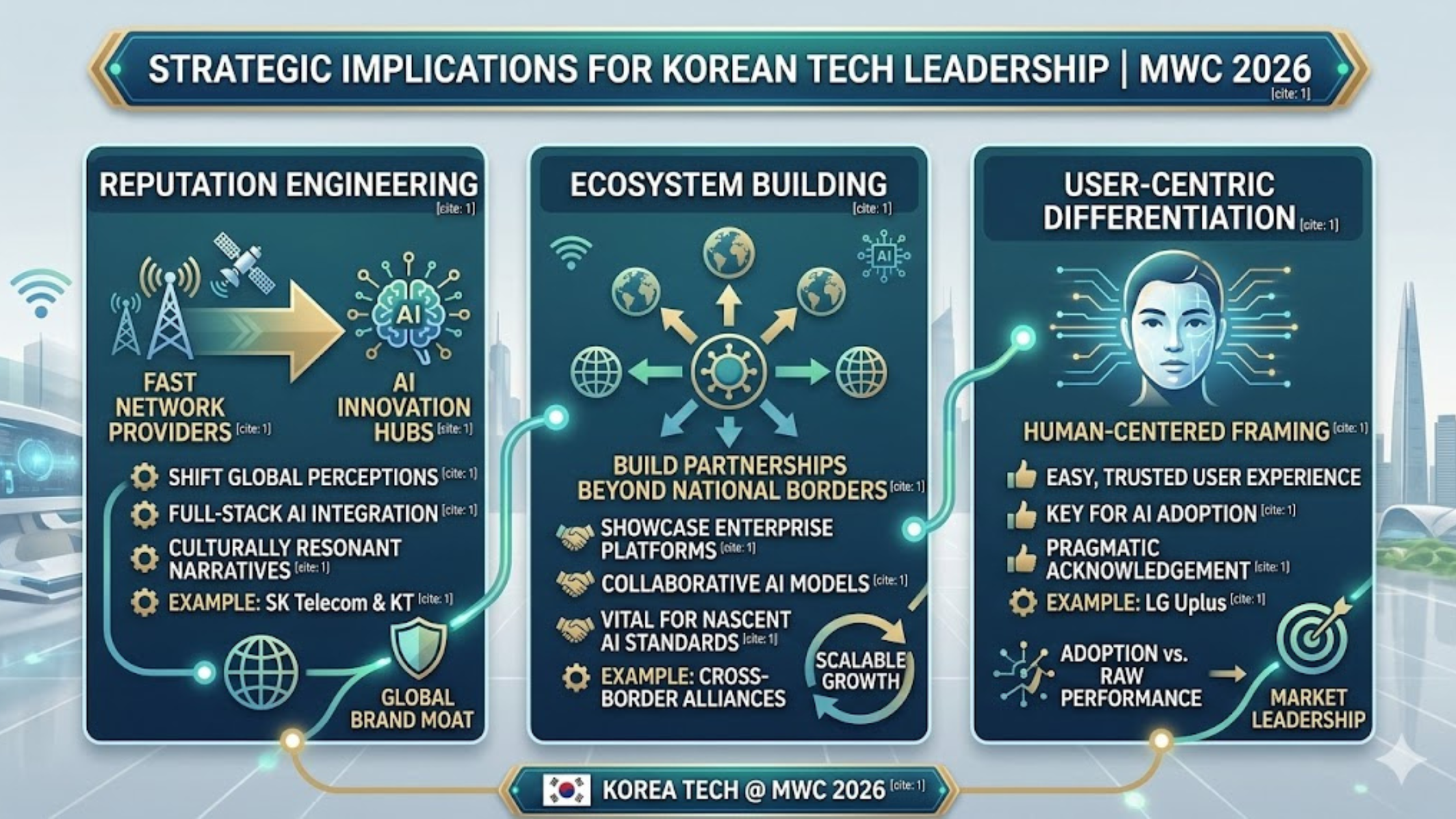
Strategic Implications for Korean Tech Leadership
The Korean approach to MWC 2026 can be interpreted through multiple strategic lenses:
- Reputation engineering: By tying Korean tech to full-stack AI and culturally resonant narratives, players like SK Telecom and KT are attempting to shift global perceptions from “fast network providers” to “AI innovation hubs.”
- Ecosystem building: Showcasing enterprise-oriented platforms and collaborative models signals an intent to build partnerships beyond national borders — vital in an era where AI services and standards are still nascent.
- User-centric differentiation: LG Uplus’s human-centered framing highlights a pragmatic acknowledgement that AI adoption hinges on easy, trusted user experiences, not just raw performance.
In these ways, Korean telecoms at MWC 2026 reflect a strategic recalibration — not just competing on connectivity, but positioning AI as the connective tissue binding networks, services, and user value together.
Ultimately, MWC 2026 is less about product demonstrations and more about narrative control. For Korean telecom operators, the event offers a global stage to signal that their future lies not in incremental network upgrades, but in embedding intelligence across infrastructure, enterprise systems and user interfaces. Whether through AI-optimized networks, agentic enterprise platforms or human-centered digital services, the message is clear: Korea intends to compete in the era where compute, data and automation define telecom value. The challenge now is execution — translating exhibition floor ambition into scalable global partnerships and sustainable revenue models. If successful, MWC 2026 may mark the moment Korean carriers moved decisively from connectivity providers to architects of AI-driven digital ecosystems.