
The AI Basic Act positions Seoul as an early global regulator, but founders fear vague rules could slow innovation
South Korea has begun enforcing a broad new set of rules for artificial intelligence, marking one of the earliest attempts by any country to regulate the technology in a comprehensive way. The AI Basic Act, which came into effect on Thursday, introduces sweeping requirements for companies that develop or use AI, placing emphasis on safety safeguards, transparency, and building public confidence in the technology.
The legislation reflects the government’s ambition to position South Korea among the world’s top three AI powers, alongside the United States and China. “The AI Basic Act comes into full effect today,” President Lee Jae Myung said, stressing that the country is moving faster than many peers, including the European Union, whose AI Act will be phased in through 2027.
How South Korea’s approach compares globally
AI regulation varies widely around the world, reflecting different policy goals and economic models. While there is no unified global standard, several major jurisdictions have adopted distinct frameworks that reveal contrasting priorities in balancing innovation with safety.
In Europe, the European Union has already passed its AI Act, a risk-based framework that classifies AI systems according to the level of harm they could pose and imposes strict obligations on high-risk applications. The EU’s rules include detailed requirements for transparency, data governance, and conformity assessments, and fines for non-compliance can reach up to 7% of global turnover — significantly higher than under South Korea’s new law.
In contrast, the United States has taken a more fragmented and lighter-touch approach so far, relying on existing laws and a mix of state and federal guidance rather than comprehensive national AI legislation. This reflects a policy emphasis on promoting innovation and avoiding burdensome regulation, although lack of a unified framework has also drawn criticism for creating uncertainty.
China has implemented detailed AI policies within a broader state-led governance model that prioritises social stability, national security, and ideological control. Its rules cover algorithms, generative services, and content labelling, and China has also proposed international efforts to shape global AI norms.
Beyond these major players, other countries are developing their own strategies. Canada has proposed the Artificial Intelligence and Data Act to ensure safety and non-discrimination, while Japan, India, and Singapore are advancing sector-specific guidelines and national AI plans rather than sweeping laws. At least 69 countries worldwide have launched more than 1,000 AI-related policy and legal initiatives, showing the global regulatory landscape is rapidly evolving.
South Korea’s decision to implement a broad, binding legal framework at this stage places it among the most assertive regulators. Unlike some jurisdictions that focus on specific use cases or rely on existing general laws, the AI Basic Act sets out comprehensive principles and obligations across the AI development and deployment lifecycle. This early, holistic approach reflects Seoul’s intent to build public trust and shape international norms, even as it raises concerns among startups about compliance burdens.
Stricter rules for “high-impact” AI systems
A central feature of South Korea’s AI Basic Act is the classification of certain applications as “high-impact” AI—systems whose failure, bias, or misuse could cause serious harm to individuals or society. These systems are subject to stricter obligations because they operate in areas where automated decisions can directly affect safety, rights, or access to essential services.
The law identifies high-impact AI as covering uses in sensitive fields such as:
- public safety and critical infrastructure, including nuclear power operations and drinking water management
- transport and healthcare, where system errors could endanger lives
- law enforcement and education, where automated decisions may affect legal outcomes or long-term opportunities
- financial services, such as credit scoring and loan screening, which can shape access to capital and economic mobility
For these applications, companies are required to keep humans meaningfully involved in decision-making. This means AI systems cannot operate as “black boxes”: developers and operators must be able to explain how outcomes are produced, respond to questions from regulators, and intervene when results appear incorrect or harmful.
Officials say the intent is not to block the use of AI in critical sectors, but to ensure accountability remains with humans. By imposing oversight and explainability requirements, the government aims to reduce the risk of unchecked automation in areas where mistakes or bias could have lasting consequences for individuals and public trust.
Transparency and deepfake controls
The law also introduces strict transparency requirements for both high-impact and generative AI. Users must be clearly informed when a service or product is powered by AI, for example through pop-up notifications. In addition, AI-generated content that could be mistaken for real images, audio, or video must be clearly labelled.
This includes deepfakes, which have drawn growing global concern. The science ministry said measures such as digital watermarks are a “minimum safety requirement” to prevent misuse of AI-generated media.
Enforcement with a grace period
The Ministry of Science and ICT said the law was designed to balance regulation with innovation. The act, passed in December 2024, spans six chapters and 43 articles and is intended to create a long-term framework rather than impose immediate restrictions.
To reduce disruption, companies will be given a grace period of at least one year before administrative penalties are enforced. During this time, regulators will prioritise guidance, consultation, and education. Even after enforcement begins, authorities say corrective orders will come before fines.
Penalties remain a concern for startups
Despite the softer rollout, penalties under the law are not insignificant. Companies that fail to properly label generative AI content could face fines of up to 30 million won (around $20,400). While this is far lower than potential penalties under EU rules—where fines can reach up to 7% of global turnover—it remains a worry for smaller firms with limited compliance resources.
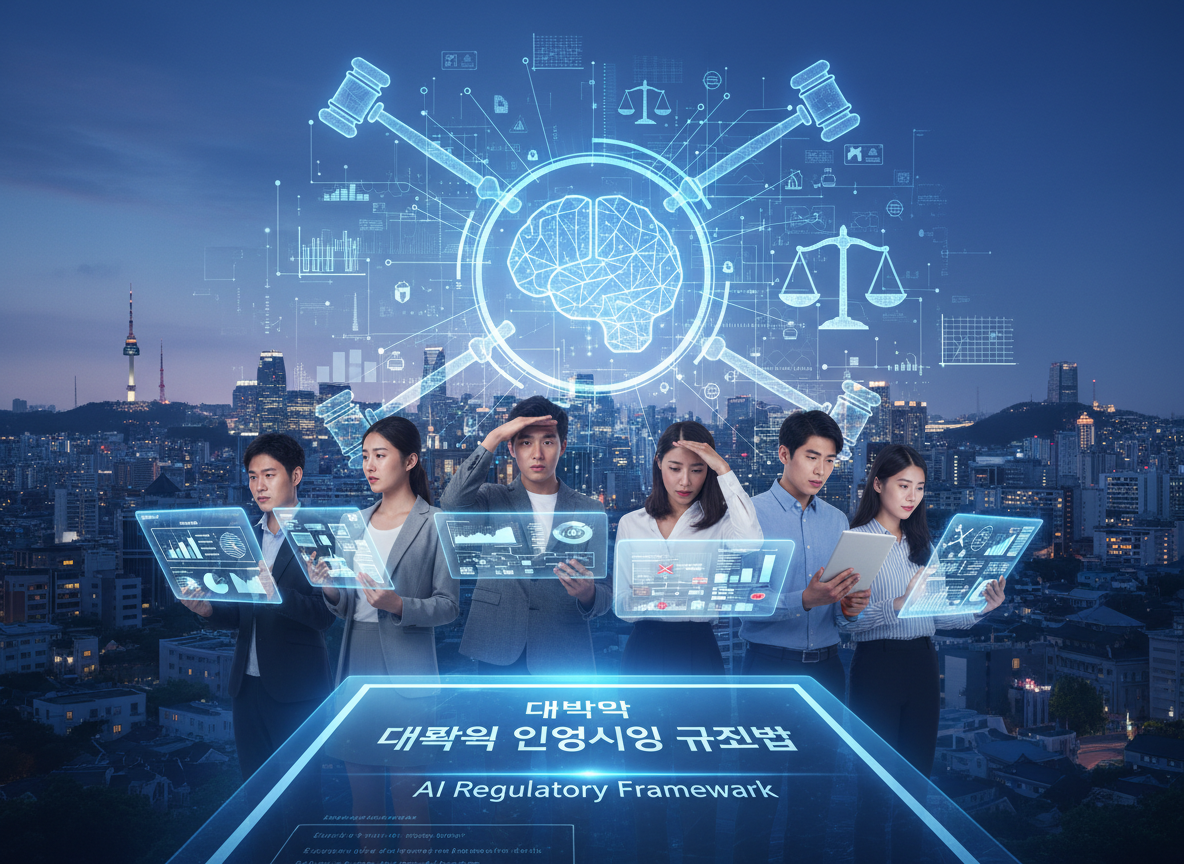
Startup groups have raised concerns that unclear definitions could discourage experimentation. Lim Jung-wook, co-head of the Startup Alliance, said many founders feel uneasy about being the first to operate under an untested regulatory framework. He warned that vague language may push companies toward safer, less innovative choices to avoid regulatory risk.
Balancing regulation with innovation
President Lee acknowledged these concerns and urged policymakers to ensure the law does not undermine growth. He said it was essential to maximise the AI industry’s potential through institutional support while managing risks early.
The science ministry said it is preparing a guidance platform and a dedicated support centre to help companies navigate compliance. Officials also indicated they may extend the grace period if domestic or international conditions justify it, signalling that the framework could evolve as the industry matures.
As South Korea moves ahead with one of the world’s most comprehensive AI regulatory frameworks, the real test will lie in how the rules are applied in practice. While the AI Basic Act sets clear expectations around safety, transparency, and accountability, its long-term impact will depend on whether regulators can provide clarity quickly enough for companies operating in fast-moving and uncertain markets.
President Lee’s call for institutional support reflects an awareness that early regulation carries both risks and opportunities. If implemented flexibly, the law could help build public trust and give Korean AI firms a regulatory head start as similar rules emerge elsewhere. But if compliance demands outpace guidance, startups and smaller developers may struggle to keep up, potentially slowing experimentation.
For now, the government’s emphasis on guidance, dialogue, and phased enforcement suggests an effort to balance oversight with growth. As global norms around AI governance continue to evolve, South Korea’s approach may serve as an early case study—showing whether comprehensive regulation can coexist with innovation in one of the world’s most competitive technology markets.