
Partnership aims to accelerate Korea’s transition to automated logistics and advance a next-generation “Logistics 4.0” model
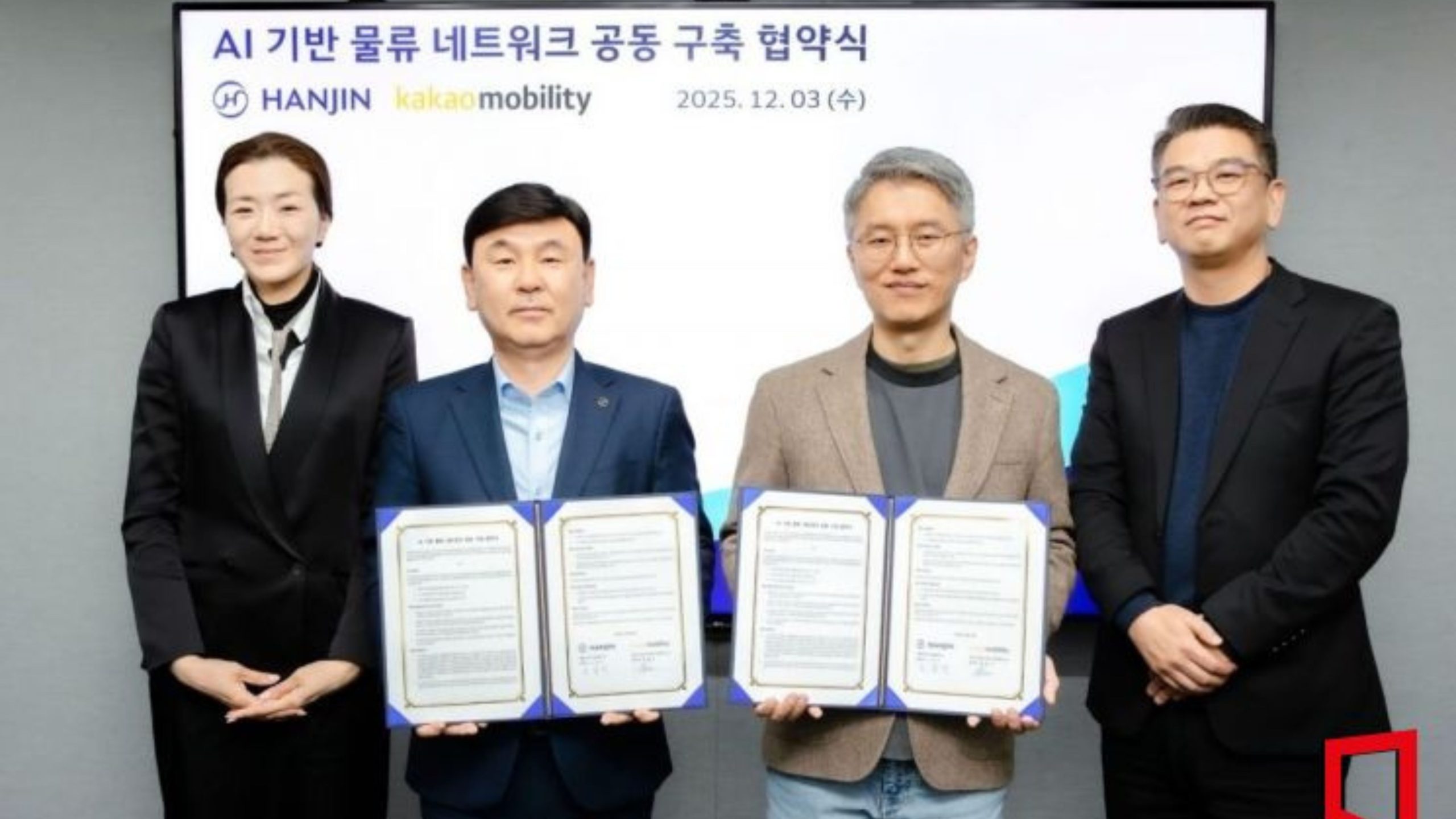
Hanjin has signed an MOU with Kakao Mobility to jointly develop an AI-driven logistics network, marking a significant move to modernize South Korea’s delivery infrastructure. The partnership will see Hanjin incorporate Kakao Mobility’s artificial intelligence and autonomous-driving technologies into its logistics operations, with the goal of building a faster and more efficient supply chain supported by digital platforms.
Central to the collaboration is the development of “Logistics 4.0,” a next-generation approach that applies automation, intelligent routing, and real-time data systems across parcel delivery and freight operations. To guide this effort, the companies will establish a joint consultative body that will design service models, coordinate technical discussions, and oversee phased implementation.
Optimizing Idle-Time Infrastructure to Boost Efficiency
A key early focus of the partnership is increasing the efficiency of Hanjin’s logistics centers during periods of low activity. By linking these facilities with Kakao Mobility’s supply chain network, the companies aim to speed up parcel movement, ease congestion, and create a more adaptable flow of goods. This coordination is expected to strengthen the entire delivery system, especially during high-demand periods when rapid processing becomes essential.
Middle-Mile Automation Positioned as Core Innovation Area
A major focus of the partnership is the middle-mile stage, where cargo moves between logistics hubs before entering the last-mile delivery process. This part of the logistics chain often determines overall efficiency and cost.
Hanjin plans to adopt Kakao Mobility’s AI logistics engine to:
- Optimize routing between logistics centers
- Reduce transit time
- Lower the number of empty truck runs
- Improve operational cost management
These improvements are designed to create a more stable and predictable logistics backbone capable of supporting high-volume freight movement.
Advanced AI Forecasting to Support Better Planning
Beyond route optimization, the two companies intend to jointly develop AI-based prediction models that use accumulated logistics data. These models will help forecast delivery demand, allowing more accurate resource allocation and reducing the likelihood of unexpected congestion.
The strengthened forecasting capabilities are expected to support long-term planning, stabilize network operations, and enhance the overall delivery experience for customers.
Long-Term Push Toward Autonomous and Smart Logistics
The partnership also includes efforts to introduce future mobility technologies into logistics operations. Both companies are accelerating development under a shared AI Transformation (AX) initiative, which aims to incorporate robotics, AI-based control systems, and autonomous freight vehicles into daily operations.
In the long run, the goal is to create:
- A fully automated logistics operation system
- Continuous 24-hour cargo movement
- Lower transportation costs
- More consistent service quality across the entire network
These technologies position the companies to compete in a logistics environment increasingly shaped by automation and digital intelligence.
Industry Perspective and Strategic Significance
A Hanjin representative emphasized the strategic importance of the collaboration, noting that digital technologies will play a critical role in reshaping Korea’s logistics landscape. “By applying AI and autonomous driving across our operations, we aim to deliver new levels of efficiency and convenience for both customers and partners,” the official said. The company added that close cooperation with Kakao Mobility will be essential as both sides refine business models and move toward real-world testing.