
KoreaTechToday - Korea's Leading Tech and Startup Media Platform
  • Topics
    • Naver
    • Kakao
    • Nexon
    • Netmarble
    • NCsoft
    • Samsung
    • Hyundai
    • SKT
    • LG
    • KT
    • Retail
    • Startup
    • Blockchain
    • government
  • Lists
KoreaTechToday - Korea's Leading Tech and Startup Media Platform
  • Topics
    • Naver
    • Kakao
    • Nexon
    • Netmarble
    • NCsoft
    • Samsung
    • Hyundai
    • SKT
    • LG
    • KT
    • Retail
    • Startup
    • Blockchain
    • government
  • Lists
KoreaTechToday - Korea's Leading Tech and Startup Media Platform
No Result
View All Result
Home Ministry of Science and ICT

Science Ministry Injects 211.5 Billion Won to Develop Space Parts Locally

KoreaTechToday Editor by KoreaTechToday Editor
PUBLISHED: April 27, 2020 UPDATED: April 28, 2020
in Ministry of Science and ICT, Science and Technology, South Korea, Space program
0
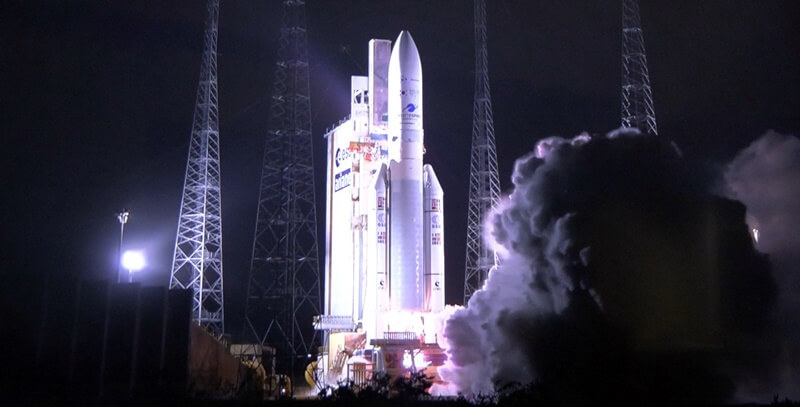
South Korea’s domestic geostationary communication satellites, Cheollian 2B, carried on the Ariane 5ECA carrier rocket.
South Korea’s domestic geostationary communication satellites, Cheollian 2B, carried on the Ariane 5ECA carrier rocket. / photo courtesy of The Ministry of Science and ICT

South Korea’s domestic geostationary communication satellites, Cheollian 2B, carried on the Ariane 5ECA carrier rocket. / photo courtesy of The Ministry of Science and ICT

South Korea’s science ministry announced on Monday that it would invest 211.5 billion won ($171.6 million) into development of local production of space parts. The ministry hopes that the capital injection would help the country’s localization of highly technological components for satellites and space launchers.

The Ministry of Science and ICT revealed its “Space Pioneer” research project that passed a feasibility study on Monday. The project, with an approved investment of 211.5 billion won ($171.6 million), aims to achieve a localization rate of 97 percent.

The ministry provided around 137.5 billion won ($112.3 million) in the satellite segment, and 58 billion won ($47.4 million) for technologies involving launch vehicles. According to the government, Space Pioneer is a 10-year project that would start in 2021.

South Korea’s space program saw slow progress as it still needs to import a great deal of parts and components for the production of satellites and launch vehicles. Other countries reluctance to transfer core technologies resulted to South Korea’s dependence on imported parts. The reliance also entailed a lot of investment in the recent years.

Korean Space Program Projects

In 2012, the country locally produced 64 percent of the parts used to make a multi-purpose satellite, while the remaining 36 percent came from other countries. South Korea produced 65 percent of parts and components for the current satellite development project.

The first South Korean-made booster engine in November 2018 for a three-stage rocket called Korea Space Launch Vehicle-2 (KSLV-2) or Nuri, successfully launched and showed a promising performance. By 2019, engineers produced the prototype for full-size propellant tanks mounted on the first stage of Nuri.

Last February, one of the country’s domestic geostationary communication satellites, Cheollian 2B, went into orbit to collect and monitor marine and atmospheric environmental data around the Korean Peninsula. The Ariane 5ECA carrier rocket carried the satellite lifting off from the Guiana Space Center located in a region of France in South America.

Tags: 211.5 billion woncapital injectioncomponentslocal productionpartsSouth Koreaspacespace program

Related Posts

ChoiceDx AI Skin Analysis Kiosk Debuts at Torriden Connect Seongsu
South Korea’s domestic geostationary communication satellites, Cheollian 2B, carried on the Ariane 5ECA carrier rocket. / photo courtesy of The Ministry of Science and ICT
AI

ChoiceDx AI Skin Analysis Kiosk Debuts at Torriden Connect Seongsu

October 1, 2026
Why Korea’s Digital Economy Could Give AI-Native Growth Teams an Edge
South Korea’s domestic geostationary communication satellites, Cheollian 2B, carried on the Ariane 5ECA carrier rocket. / photo courtesy of The Ministry of Science and ICT
South Korea

Why Korea’s Digital Economy Could Give AI-Native Growth Teams an Edge

October 1, 2026
AI Ads Can Win Attention. But What Happens to Brand Trust?
South Korea’s domestic geostationary communication satellites, Cheollian 2B, carried on the Ariane 5ECA carrier rocket. / photo courtesy of The Ministry of Science and ICT
AI

AI Ads Can Win Attention. But What Happens to Brand Trust?

September 1, 2026
K-Beauty Has the U.S. Audience. Can Other Korean Startups Replicate the Playbook?
South Korea’s domestic geostationary communication satellites, Cheollian 2B, carried on the Ariane 5ECA carrier rocket. / photo courtesy of The Ministry of Science and ICT
AI

K-Beauty Has the U.S. Audience. Can Other Korean Startups Replicate the Playbook?

September 2, 2026
Korean Healthtech Startups Want to Go Global. They May Need Local Partners More Than Local Technology.
South Korea’s domestic geostationary communication satellites, Cheollian 2B, carried on the Ariane 5ECA carrier rocket. / photo courtesy of The Ministry of Science and ICT
South Korea

Korean Healthtech Startups Want to Go Global. They May Need Local Partners More Than Local Technology.

September 2, 2026
How Mind Cafe Is Using Technology to Scale Human Counseling Across South Korea
South Korea’s domestic geostationary communication satellites, Cheollian 2B, carried on the Ariane 5ECA carrier rocket. / photo courtesy of The Ministry of Science and ICT
AI

How Mind Cafe Is Using Technology to Scale Human Counseling Across South Korea

September 2, 2026
No Result
View All Result

Most Popular

  • FTC Imposes 72.4 Billion Won Fine on Kakao Mobility Over Antitrust Violations

    0 shares
    Share 0 Tweet 0
  • Kakao Mobility Faces $10.5 Million Fine for Limiting Competitors’ Access to Taxi Platform

    0 shares
    Share 0 Tweet 0
  • Kakao Mobility and Kia collaborate to develop purpose-built vehicle for ride-hailing services

    0 shares
    Share 0 Tweet 0
  • Samsung and SK Hynix Face New U.S. Licensing Rules for Chinese Chip Plants

    0 shares
    Share 0 Tweet 0
  • Kakao Mobility Pilots Korea’s First Robot Valet: A Step Toward Fully Automated Urban Mobility

    0 shares
    Share 0 Tweet 0
  • AI Ads Can Win Attention. But What Happens to Brand Trust?

    0 shares
    Share 0 Tweet 0

PRODUCTS

[ads_amazon]

TOPICS

  • Naver
  • Kakao
  • Nexon
  • Netmarble
  • NCsoft
  • Samsung
  • Hyundai

FREE NEWSLETTER

[mc4wp_form id="4726"]

FOLLOW US

  • About Us
  • Cookie policy
  • home
  • homepage
  • mainhome
  • Our Services
  • Privacy Policy
  • Terms of Use

Copyright © 2024 KoreaTechToday | About Us | Terms of Use |Privacy Policy |Cookie Policy| Contact : [email protected] |

No Result
View All Result
  • Topics
    • Naver
    • Kakao
    • Nexon
    • Netmarble
    • NCsoft
    • Samsung
    • Hyundai
    • SKT
    • LG
    • KT
    • Retail
    • Startup
    • Blockchain
    • government
  • Lists

Copyright © 2024 KoreaTechToday | About Us | Terms of Use |Privacy Policy |Cookie Policy| Contact : [email protected] |